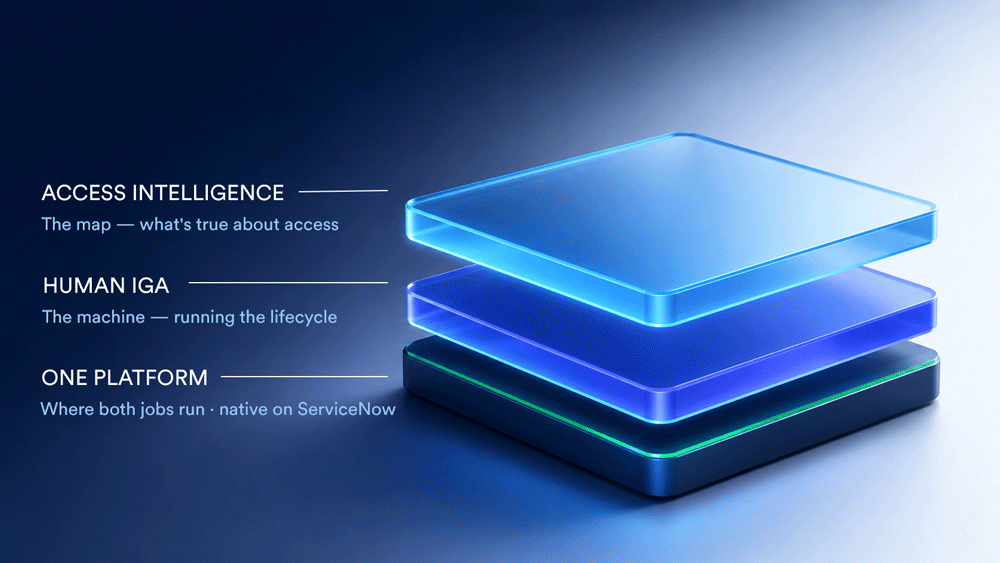
Identity Governance Doesn’t Have an Automation Problem. It Has an Understanding Problem.
Identity teams don’t lack tools. They lack the one thing every decision depends on — a clear view of what’s actually true.
Read Now


For years, organizations have talked about the relationship between identity and security. Every strategy deck says the same thing: Identity is the new perimeter.
And every breach report reinforces it.
But here’s the uncomfortable truth:
If identity and security are so tightly linked, why do they still operate as separate systems of action?
Most enterprises believe they’ve consolidated identity and security. In reality, they’ve consolidated tools — not architecture.
What still exists underneath is fragmentation across:
• One system where access is requested
• Another system where access is provisioned and enforced
• A separate identity governance layer for certifications and reviews
• A different security operations stack for detection and response
• And yet another system for risk, audit, and regulatory compliance
Each system may be “integrated.”
Few are truly unified.
This kind of fragmentation doesn’t just create operational drag — it fragments accountability across systems that were never designed to work as one.
And when accountability fragments, risk expands.
CIOs and CISOs now face a strategic inflection point:
It’s time for identity and security to finally converge.
Not in theory.
Not in PowerPoint.
But in the platform architecture itself.
Identity governance has historically lived in its own silo. Separate teams, separate admins, separate data models.
But modern threats don’t respect silos.
Lateral movement, credential abuse, MFA fatigue, high-risk insider activity—these are identity-driven security events. And yet the systems responsible for identity signals are often disconnected from the systems responsible for security response.
This architectural split creates three major issues:
1. Slow, incomplete visibility
Security teams can only see identity activity once it hits their tools, which is often too late.
2. Policy without enforcement
Policies defined in GRC or audit frameworks rarely tie directly into the identity workflows that enforce them.
3. Data without context
Identity logs lack the business context that ITSM, HR, SecOps, and GRC systems already contain.
CIOs and CISOs cannot continue defending identity-driven threats with architectures that separate identity from the systems that operationalize it.
The solution isn’t “better integration.”
It’s unification.
When identity governance runs on the same platform as ITSM, SecOps, and GRC, the entire enterprise gains:
A single source of truth
Identity joins the same data model used to manage incidents, vulnerabilities, approvals, and compliance.
A single workflow engine
Lifecycle events and access changes follow the same automation paths as tickets, change requests, and risk workflows.
A single audit trail
No more reconciling identity events with security controls stored somewhere else.
A single accountability map
Security, IT, and compliance teams operate from the same playbook—not three different systems with conflicting logic.
This is what true identity–security convergence looks like:
Policy, enforcement, and operational response living on the same platform.
Consolidating identity governance into platforms like ServiceNow does more than reduce tool sprawl—it closes the dangerous gaps between:
• Who should have access
• Who does have access
• How access is granted or removed
• How policy is enforced
• How security responds when something goes wrong
This convergence supports the priorities modern leaders care most about:
• Enterprise security resilience
Risk signals flow directly from identity into SecOps and GRC.
• Governance maturity
Lifecycle events and certifications tie directly to compliance frameworks.
• Zero Trust
Access workflows become continuous, contextual, and policy-led.
• ROI alignment
The business spends less on connectors, integrations, and legacy tools—and more on strategic modernization.
In other words:
When identity and security finally converge, risk goes down and value goes up.
Clear Skye is the only identity governance solution built natively on the ServiceNow Platform—the same platform CIOs and CISOs already rely on for:
• ITSM
• SecOps
• GRC
• Risk
• HR workflows
• Enterprise operations
Because Clear Skye runs inside the platform—not alongside it—organizations gain:
• Unified data
• Unified workflows
• Unified auditability
• Unified response capability
• Unified governance
This is the foundation for true identity–security convergence.
Not stitched together.
Not integrated.
Native.
CIOs and CISOs need architectures that make identity a first-class security signal—not a bolted-on indication that arrives after the fact.
And the organizations that unify identity governance into their enterprise platforms will build stronger, more resilient security programs with far less complexity.
Identity and security aren’t converging because vendors say they should.
They’re converging because the business now depends on it.
And Clear Skye is helping organizations finally make that convergence real.