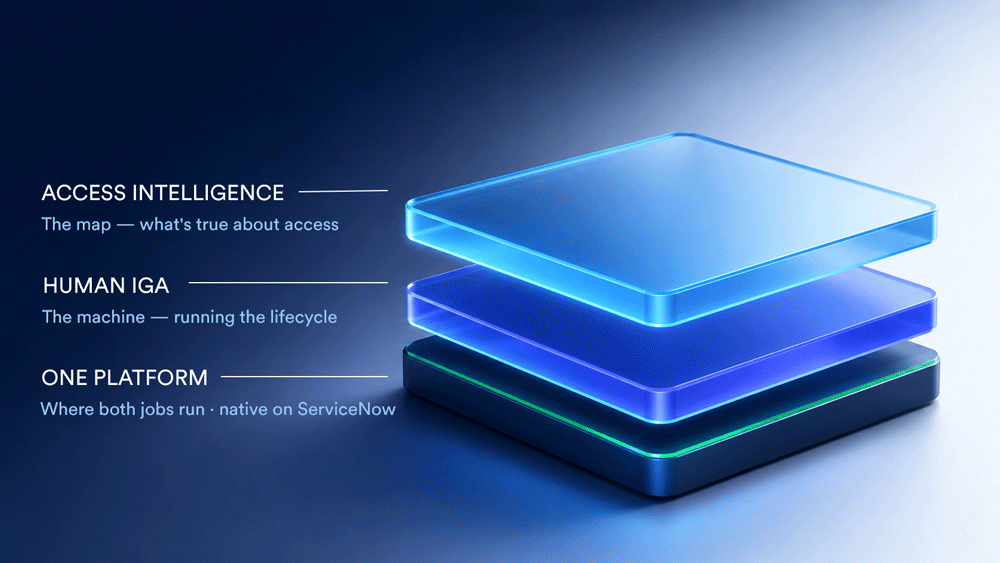
Identity Governance Doesn’t Have an Automation Problem. It Has an Understanding Problem.
Identity teams don’t lack tools. They lack the one thing every decision depends on — a clear view of what’s actually true.
Read Now

For CIOs and CISOs, few initiatives carry as much hidden risk as identity modernization.
On paper, modernizing identity governance sounds straightforward: improve visibility, strengthen controls, reduce technical debt, and prepare for the future.
In practice, it often feels dangerous.
Executives worry about:
• Downtime during migration
• Broken access for employees or customers
• Failed integrations
• Audit exposure
• Reputational risk
Identity touches everything. When it breaks, the business feels it immediately.
So many organizations delay modernization—not because they don’t see the need, but because the perceived risk feels too high.
For years, identity programs have been framed around a false tradeoff:
You can modernize, or you can stay stable.
You can improve governance, or you can avoid disruption.
But not both.
This mindset keeps organizations trapped in aging architectures that grow more fragile over time.
Legacy tools accumulate workarounds.
Manual processes multiply.
Integrations become brittle.
Key employees become single points of failure.
Ironically, the longer modernization is postponed, the greater the operational risk becomes.
Large-scale IGA transformations often struggle for the same reasons:
1. “Big Bang” Migration Plans
Replacing everything at once increases complexity and amplifies failure risk.
2. Disconnected Architectures
New tools are layered on top of old ones, creating more moving parts.
3. Business Disruption
Projects focus on technology first and operations second.
4. Change Fatigue
Teams are overwhelmed by new interfaces, workflows, and controls.
The result: stalled initiatives, partial deployments, and frustrated stakeholders.
Leading organizations are taking a different approach.
Instead of ripping and replacing, they modernize identity by embedding it into the platforms that already run the business.
This enables phased transformation without destabilizing operations.
A large healthcare system, for example, began by moving access requests and approvals into ServiceNow—while leaving provisioning systems untouched.
Once workflows stabilized, they added certifications.
Then lifecycle automation.
Then security integrations.
Each phase delivered value on its own.
No disruption.
No downtime.
No emergency rollbacks.
This approach follows three principles:
1. Start with Workflows
Modernize how identity decisions are made before changing how access is technically enforced.
2. Consolidate the Control Plane
Centralize approvals, certifications, and policy management first.
3. Migrate Systems Gradually
Replace legacy components only when business processes are stable.
By separating governance from enforcement during early phases, organizations reduce operational risk.
Modernization succeeds when continuity is treated as a core requirement—not an afterthought.
That means:
• Maintaining parallel systems during transitions
• Preserving audit trails
• Avoiding forced process changes
• Supporting existing integrations
• Phasing user experience changes
Identity modernization becomes evolution, not disruption.
This approach works best when identity governance runs on an enterprise platform.
When identity lives on ServiceNow, organizations gain:
• A stable workflow foundation
• Built-in change management
• Shared operational context
• Enterprise-grade resilience
• Familiar user experience
Instead of introducing a new operational layer, modernization builds on existing infrastructure.
Clear Skye was designed for this model.
Because it runs natively on ServiceNow, organizations can modernize identity governance without introducing new platforms, databases, or workflow engines.
The platform absorbs change.
The business keeps moving.
Organizations following this approach consistently report:
• Faster time to value
• Fewer implementation setbacks
• Higher stakeholder confidence
• Improved audit readiness
• Stronger security posture
Most importantly, modernization stops being a “project” and becomes a continuous capability.
Modernizing identity isn’t just about today’s risk.
It’s about preparing for:
• AI-driven governance
• Machine identities
• Zero Trust enforcement
• Continuous compliance
• Real-time risk scoring
None of these are possible on fragmented architectures.
Incremental, platform-based modernization lays the foundation.
CIOs and CISOs don’t need to choose between stability and progress.
With the right architecture, they can have both.
Modern identity governance can be:
• Phased
• Controlled
• Measurable
• Resilient
And it can happen without disrupting the business.
If you’re evaluating how to modernize identity governance without risking operations, seeing the platform in action can clarify the path forward.
Explore Clear Skye’s self-guided demo to experience incremental, platform-native modernization firsthand.